
Safety Keychain Set with Pepper Spray and Taser: 7 Things to Check Before You Buy

Safety Keychain Set with Pepper Spray and Taser: 7 Things to Check Before You Buy
A safety keychain set with pepper spray and taser sounds like the complete answer. One small kit on your keys, with a spray that works from a distance and a taser-style device for close range, plus usually an alarm and a few smaller tools. Buy the set, clip it on, and you are covered. That is the promise, and it is a good promise — as long as you know what is actually in the set and what each piece can and cannot do.
The idea behind a safety keychain set with pepper spray and taser is layering. No single tool works in every situation. Pepper spray keeps distance between you and someone approaching. A taser or stun gun works when that distance is already gone. An alarm draws attention. Each piece covers a gap the others leave open. But a set only helps if every piece is one you can reach, use, and legally carry — and if the set is not so bulky that you stop carrying it after a week.
This guide covers what is usually in the set, how the pepper spray and the taser parts actually work, what to check before you buy, and how to carry the whole kit every day.
What a Safety Keychain Set with Pepper Spray and Taser Actually Contains
Most sets sold under this name contain the same core pieces, though the exact contents vary from seller to seller, so always read the listing before you buy.
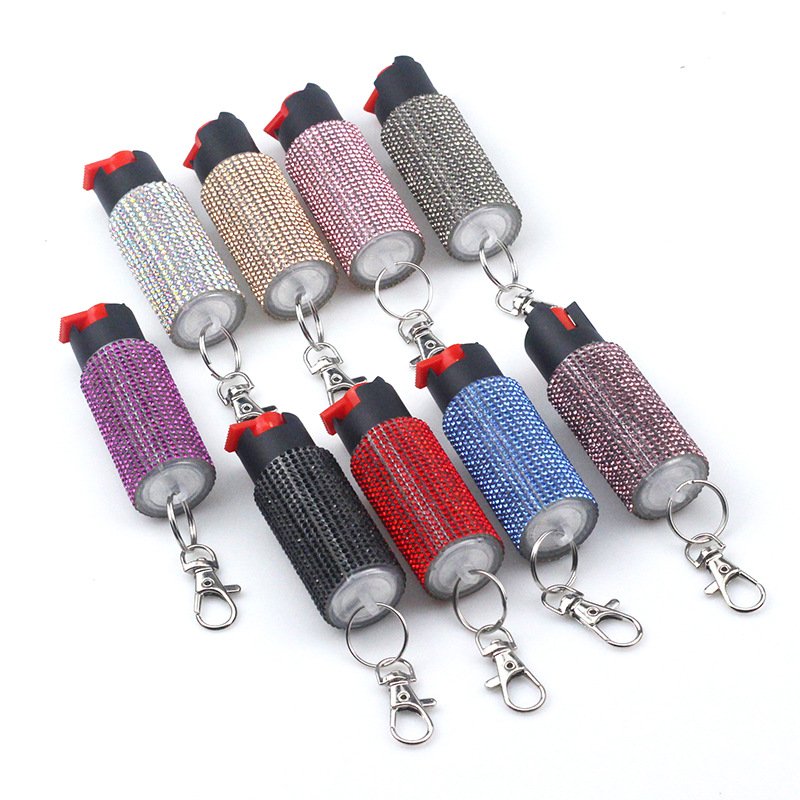
The pepper spray is usually a small canister, about half an ounce, on a quick-release key ring. It sprays a stream of oleoresin capsicum — the irritant in hot peppers — that burns the eyes, nose and throat and forces them shut for a short time. Good ones reach several feet, have a safety catch so they do not go off in your bag, and carry a UV dye that marks skin under ultraviolet light.
The taser part is usually a small contact stun gun, sometimes shaped like a lipstick or a phone, and sometimes a TASER-style device that fires probes on wires. The two are different, and the difference matters: a contact stun gun only works when you press it against someone, while a TASER-style device works from several metres away but is bigger, heavier and usually much more expensive. Most keychain sets contain the contact kind. If a listing says “taser” without saying which kind, ask — or assume it is a contact stun gun and judge it on that basis.
Around those two main pieces, sets usually add a personal alarm, a small loud siren you pull or press that draws attention, and one or two smaller tools: a kubotan stick, a cat ear keychain, a window breaker, a whistle, or a flashlight. Some add a pom-pom or a wristlet strap, which are decoration, not defence — nice to have, but they do not make the set safer.
The honest way to judge a set is to judge each piece on its own. A set with a good spray and a weak stun gun is a good spray with a paperweight attached. A set with a good stun gun and a spray that barely reaches two feet has the opposite problem. Buy the set for its two main tools, and treat everything else as a bonus.
How the Two Tools Work Together
Pepper spray and stun guns solve different problems, and that is why they are sold together. Understanding pepper spray and stun guns as a pair, rather than as rivals, is the whole point of a combination set.
Pepper spray is your distance tool. You use it first, when someone is still a few steps away, before they can touch you. It needs no contact, it works even if your hands are shaking, and it gives you time — usually enough time to run. Its weaknesses are wind, which can blow spray back toward you, and enclosed spaces, where the spray affects everyone in the room, including you.
A taser or stun gun is your close-range backup. You use it when the distance is already gone — when someone has grabbed you, or is close enough to grab you. It needs direct contact, it needs a charged battery, and it stops working the moment you stop touching the person with it. Its strength is that it is not affected by wind, it works in the rain, and the loud crackle of a test fire alone can make someone step back.
The order matters: spray first if you have the distance, stun gun second if you do not. That is the sequence to practise. Reach for the spray on your key ring first, because it is the tool that keeps you furthest from danger. If the spray is empty, jammed, or the wind is wrong, the stun gun is still in your hand. A set gives you that second chance. A single tool does not.
Pepper Spray: Your Distance Tool
The pepper spray in a safety keychain set is small, and small means compromises. A half-ounce canister holds only a short burst — often 25 bursts or fewer, and sometimes far less. That is enough for one or two uses, not a whole evening of practice. Do not waste it testing the spray in the air; test the safety catch and the grip instead, and replace the canister when it is old. Most sprays lose pressure after two to four years, and an expired canister is the most common way a good set fails.
Check three things about the spray before you buy the set. First, the safety: a flip-top or twist safety that you can open with one hand but that will not open by accident in your bag. Second, the grip: a finger groove or a small loop that lets you aim without looking. Third, the range and the pattern: a stream reaches further and is less affected by wind than a mist or a fog, which is what you want outdoors.
For a fuller guide to choosing a spray on its own, including how to practise with it and what the law says in different places, see our guide to pepper spray for women. The rules in that guide apply to the spray in your set exactly the same way.
Taser or Stun Gun: Your Close-Range Backup
The taser or stun gun in a set needs the same honest check. Start with the kind. If it is a contact stun gun, it only works at arm’s length, so ask yourself whether you are comfortable with a tool that needs you to be that close. If it is a TASER-style device with probes, it gives you distance, but it is bigger, it costs more, and once you have fired it you usually cannot fire it again until you reload it.
Then check the battery. Most small stun guns are rechargeable, which is good — but only if you actually charge them. A dead stun gun is a paperweight, and a set that has sat in a drawer for six months is almost certainly dead. Put a monthly charging reminder in your phone, the same day every month, and test-fire the device into the air for a second to confirm it still crackles.
Then check the safety switch and the grip. The safety should be firm enough that it cannot switch on in your bag, and easy enough to flip off in a hurry. Hold the device the way you would hold it scared — one hand, no looking down. Can you find the trigger by feel? Does it sit in your palm without slipping? If it twists in your grip, it is the wrong size for your hand, no matter how good its specifications look.
Ignore the enormous voltage numbers on the packaging. Sellers advertise tens of millions of volts, but voltage on its own does not tell you how effective a device is. What matters is the combination of voltage and current, the quality of the battery, and whether the electrodes make solid contact. A seller who will not say what battery the device uses or how long a charge lasts is selling a shape, not a tool.
For a fuller guide to choosing one on its own, including the difference between contact and TASER-style devices, see our guide to stun gun for women.
The Rest of the Set: Alarm, Kubotan, and the Small Pieces
The personal alarm is the most underrated piece in the set. It is also the only piece that works everywhere — there is no place where a loud noise is illegal. A good alarm is 120 decibels or louder, it is activated by pulling a pin or pressing a button, and it keeps sounding until you switch it off. Use it first, before anything else, whenever you can: attention is the thing an attacker wants least, and an alarm buys you witnesses.
A kubotan stick or a cat ear keychain concentrates the force of your grip into a small point. They are useful if you know the two basic grips, and useless if you do not — an unfamiliar tool in a scared hand is just a hard stick. If your set includes one, spend an hour learning how to hold it, or leave it off the key ring until you do. Our kubotan guide covers the two grips and how to practise them.
A window breaker is a small hardened point for breaking car glass in an emergency. It is a rescue tool, not a defence tool, and it only helps if you know where it is on your key ring. A flashlight is genuinely useful on a dark walk, and a bright light in someone’s eyes buys a second of hesitation. A whistle is a backup to the alarm. None of these pieces makes the set safer on their own — they make it more useful, which is a different thing, and a useful set is a set you will keep carrying.
7 Things to Check Before You Buy
First, check the spray: safety catch, grip, stream pattern, and expiry date. Second, check the stun gun: contact or TASER-style, battery type, safety switch, and grip in your hand. Third, check the alarm: how loud, how it activates, and whether it keeps sounding. Fourth, check the weight and the size: hold the whole set on your keys and walk around with it for a day — if it is too heavy or too bulky, you will leave it at home, and a set at home helps no one. Fifth, check the key ring and the quick release: can you get the spray off the ring in two seconds without looking? Sixth, check what is actually included: read the listing, not the product name — “taser” on the box does not guarantee a TASER-style device inside. Seventh, check the law where you live: pepper spray and stun guns are restricted in different places, and the rules for carrying them are not the same as the rules for buying them.
If a set fails any one of those seven checks, it is not a bargain — it is a set you will not be able to use when it matters.
Carrying the Set Every Day
A safety keychain set only works if it is on the keys you actually use, and if you can reach each piece without looking. Clip the set to your main key ring, not to a spare set in a drawer. Put the spray where your thumb falls when you grab your keys, and the stun gun where your fingers close around it. The test is simple: can you get the spray off the ring and into your hand within two seconds, while you are holding a shopping bag? If not, move it.
Practise the sequence, not just the pieces. Spray first, then stun gun, then run — in that order, ten times, until your hands know it without thinking. Practise drawing the set from a coat pocket, from the bottom of a tote, from a bag on your shoulder. The point is not to look skilled. The point is that your hand finds the right tool before your brain has to think about it.
And keep the set maintained. Charge the stun gun once a month. Check the spray’s expiry date twice a year. Replace the alarm battery when it sounds weak. A set that is maintained is a set you can trust, and a set you trust is a set you will carry.
Know the Law Before You Carry One
Rules about pepper spray and stun guns differ by place, and they differ from each other. Pepper spray is legal in all 50 US states, but some states limit the size of the canister or the formula, and some places — schools, airports, courthouses — ban it regardless of state law. Stun guns are legal in most states, but a few states and cities restrict them, and the rules for a TASER-style device that fires probes can be different from the rules for a contact stun gun.
Outside the US the rules are stricter in many countries, and in some places both pepper spray and stun guns are prohibited entirely. This is general information, not legal advice. Before you buy or carry a set, check the rules where you live, where you work, and anywhere you plan to travel — and check the rules for each piece separately, because a set that is legal to buy is not always legal to carry everywhere. If you are unsure, ask a local lawyer or a self-defence instructor in your area. A tool that is fine at home and a problem somewhere else is a tool that needs to stay home when you travel.
Is a Set Like This Right for You
A safety keychain set with pepper spray and taser suits a woman who wants layers — distance first, a close-range backup second, and an alarm that works anywhere — and who is willing to spend an hour learning the sequence and a few minutes a month keeping the set charged and in date. It does not suit someone who wants a single tool and nothing else, and it does not suit someone who will not practise, because a set you cannot use in order is just a heavy key ring.
If you decide to get one, buy it for its two main tools, check all seven things above, carry it on your everyday keys, and practise the sequence until it feels boring. Boring is good. Boring means your hand knows what to do. And remember what every one of these tools has in common: the goal is never to win a fight. The goal is to get away.
Frequently Asked Questions
What is in a safety keychain set with pepper spray and taser?
Usually a small pepper spray canister, a contact stun gun (sometimes a TASER-style device), a personal alarm, and one or two smaller tools such as a kubotan, a cat ear keychain, a window breaker or a flashlight. The exact contents vary by seller, so read the listing before you buy — “taser” on the box does not guarantee a TASER-style device inside.
Is pepper spray or a taser better?
They solve different problems. Pepper spray works from several feet away and is the better first option when you have distance. A taser or stun gun works at close range, when someone is already near enough to touch you. In a set, the order is spray first if you have the distance, stun gun second if you do not — then run.
Is a safety keychain set with pepper spray and taser legal to carry?
It depends on where you live, and the rules for pepper spray and for stun guns are not the same. Pepper spray is legal in all 50 US states with some limits on size and formula; stun guns are legal in most states but restricted in a few. Secure places such as airports and schools commonly ban both. Outside the US the rules are often stricter. Check your local rules before you carry a set — this article is not legal advice.
How long does the pepper spray in a set last?
A half-ounce canister holds only a short burst, often 25 bursts or fewer, and most sprays lose pressure after two to four years. Check the expiry date twice a year and replace the canister when it is old. Do not waste the spray testing it in the air; test the safety catch and the grip instead.
Do I need training to use a set like this?
You can get basic benefit from it without training, but an hour of practice makes a real difference. Learn the sequence — spray first, stun gun second, then run — practise drawing each piece from your keys without looking, and learn the two grips for the kubotan if your set includes one. A local self-defence class can teach the sequence properly in one session.