
Personal Alarm Keychain for Women: How to Pick One You’ll Actually Carry

Personal Alarm Keychain for Women: How to Pick One You’ll Actually Carry
A personal alarm keychain for women is the simplest safety tool you can own. No blade, no spray, nothing to aim. You pull a pin or press a button, and it makes a sound so loud that everyone nearby turns around. That’s the whole point — an attacker wants silence and privacy, and a good alarm takes both away in a second.
The catch is the same as with any safety gear. The best alarm in the world does nothing sitting in a drawer. So the real question is not which alarm is the loudest on paper — it is which one you will actually clip to your keys and carry every single day.
What a personal alarm keychain for women actually does
A personal alarm is a small electronic device, usually the size of a key fob, with a built-in siren and often a flashing light. When you trigger it, it emits a piercing sound — most good ones are rated between 120 and 130 decibels — and keeps sounding until you switch it off or the pin is pushed back in.
To put that in perspective, 130 decibels is louder than a thunderclap heard up close, and far louder than a person shouting. It can be heard from several hundred feet away, even through walls and closed windows. That noise does two things at once: it startles the person threatening you, and it tells everyone within earshot that something is wrong. Most attackers are counting on nobody noticing. A siren ruins that plan.
Unlike pepper spray or a stun device, a personal alarm is legal almost everywhere, including all 50 US states, because it is a non-violent device. It needs no permit, no training, and no practice to use. That makes it a good first safety tool, especially if you are not comfortable carrying anything else.
Start with volume — 120 decibels is the floor
Volume is the one number that matters most, so check it before anything else. When you’re choosing a personal alarm keychain for women, look for a siren rated at 120 decibels or higher. Below that, the sound is closer to a loud phone ringtone than a real alarm, and it will not carry far enough outdoors or in a car park.
Most well-made personal alarm keychains for women sit between 120 and 140 decibels. The difference between 120 and 130 is bigger than it sounds — decibels are logarithmic, so a small increase means a much louder siren. If you’re choosing between two similar alarms, take the louder one, as long as it’s still small enough to carry.
One warning: do not test a 130-decibel alarm next to your ear. Trigger it at arm’s length the first time so you know what to expect, and warn anyone nearby. It is genuinely painful up close, which is exactly why it works.
Activation: pull-pin beats a tiny button
When you are scared, your hands shake and your fine motor skills drop away. That is the worst moment to hunt for a small button you have never pressed before. This is why activation style matters as much as volume.
The most reliable design for a personal alarm keychain for women is the pull-pin. You pull a small pin out of the device and the siren starts at once. It does not need you to aim, press precisely, or even look at the device, and you can trigger it by tugging a wrist strap or letting go of the pin if someone grabs the alarm.
Button-activated alarms can work too, but look for one with a large, obvious button that you can find by touch alone. If the button is small, recessed, or needs two presses, skip it. And whatever you buy, trigger it once at home — in a safe place, away from your ears — so the motion is familiar before you ever need it for real.
A useful guide to decibel levels and activation types is this overview of loud alarms for women from FightSense.
Size and weight decide whether it gets carried
Here is the honest truth about a personal alarm keychain for women: the one you carry is infinitely better than the one you leave at home.
A good personal alarm keychain for women is small and light enough to live on your keyring permanently, next to your house and car keys. If it is bulky, heavy, or awkwardly shaped, you will start leaving it in your bag, then in your car, then at home. At that point it protects nobody.
Before you buy, think about where it will actually live. On a keyring? Clipped to a bag strap? On a lanyard for running? The best designs come with a sturdy keyring or clip included, not as an extra you have to buy later. If you run or walk at night, a model with a wrist strap or belt clip earns its keep.
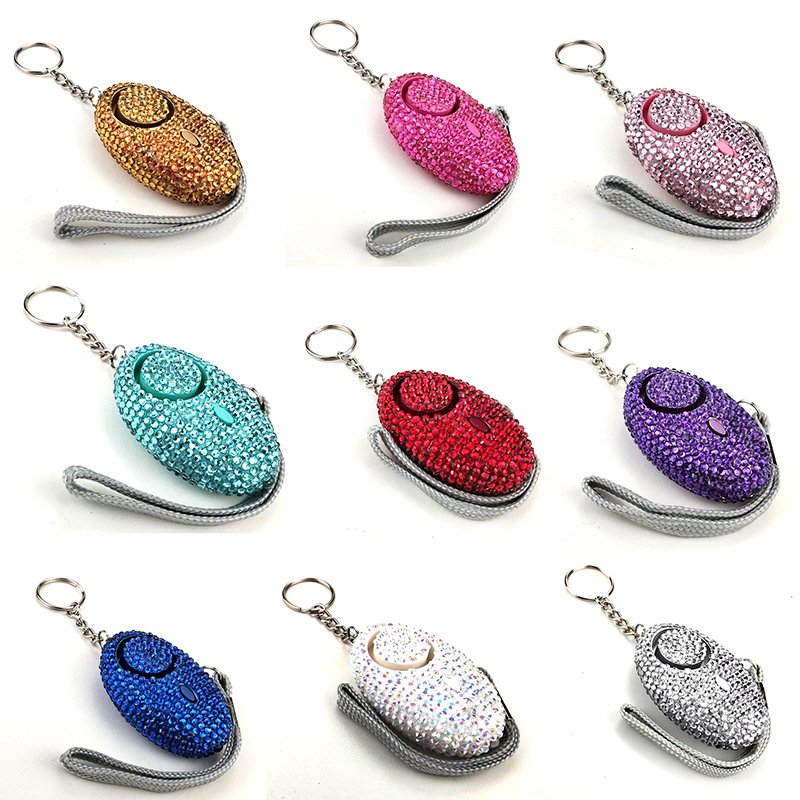
Style matters more than people admit. If you like how it looks — a colour you would choose, a shape that does not scream “safety device” — you are simply more likely to carry it. There is nothing vain about that. Carrying it is the entire job. If you want to compare colours and styles side by side, browse our personal alarms and pick one you will actually enjoy carrying.
Battery: replaceable or rechargeable, just know which
Personal alarms come in two kinds, and neither is wrong — but you need to know which one you own.
Replaceable-battery models usually take a small coin battery (often a CR2032) and can sit unused for months. They are simple and dependable, but the battery will eventually die quietly, and you will not know until you need the alarm. Put a reminder in your phone to test it every month or two.
Rechargeable models charge over USB and often last longer per charge, but they need you to remember to plug them in. If your phone is always dying, a rechargeable alarm will probably die with it.
Whichever personal alarm keychain for women you choose, test the alarm regularly. Press it for two seconds, confirm it still screams at full volume, and if it sounds weak, replace or recharge the battery.
Extra features worth having — and ones to skip
A built-in LED flashlight is genuinely useful. It helps you find your keys, walk to your car in a dark car park, and see a lock at night. Many alarms add a flashing strobe mode, which draws even more attention when the siren is going. Both are worth having if they do not make the device much bigger.
Water resistance is worth checking if you run in the rain or carry your keys in a wet bag. You do not need a fully waterproof alarm, but a splash-resistant one will survive real life better.
What you can skip: alarms that promise to call for help over Bluetooth, or ones that only work through a phone app. Those depend on your phone being charged, paired, and in range — three things you cannot count on in an emergency. A standalone alarm that makes noise with no phone, no signal, and no app is the reliable choice.
Who should carry one
Everyone, honestly — but a personal alarm keychain for women is especially worth having in a few situations:
- Students walking across campus at night, especially between the library, the car park, and halls.
- Runners and early-morning walkers, who are out when streets are quiet.
- People who travel alone, whether for work or on holiday, in places they do not know well.
- Anyone who works late shifts and walks to a car or a bus stop after dark.
- Teenagers, for whom a loud, legal, non-violent device is often the most appropriate first safety tool.
If you already carry a self-defence keychain set, a personal alarm fits right into it — the alarm is the noise-maker, and the rest of the set covers the rest. If you are starting from scratch, our guide to choosing a keychain set is a good place to begin: https://girlsselfdefence.com/womens-self-defence-keychain-set-how-to-choose-one-youll-actually-carry
How to use it if you ever need it
No one buys a personal alarm keychain for women hoping to use it. But knowing the plan in advance means you will not freeze if you ever need it.
- Trigger it early. Do not wait until someone grabs you. If someone is following you or making you feel unsafe, pull the pin while there is still distance between you.
- Keep moving toward people and light. The alarm buys you attention; use it to get to a shop, a busy street, or a group of people.
- Do not stop to explain. You do not owe anyone a reason for sounding an alarm. Your safety comes first.
- Replace the pin only when you are safe. The siren stopping early tells everyone nearby that the danger has passed — make sure it actually has.
What to look for when you buy a personal alarm keychain for women
A quick checklist before you check out:
- Siren rated 120 decibels or higher (130 is better).
- Pull-pin activation, or a large button you can find by touch.
- Small and light enough to live on your keyring permanently.
- Battery type you will maintain — replaceable with a monthly test, or rechargeable with a charging habit.
- LED light or strobe included, without much extra bulk.
- Sturdy keyring or clip in the box, not sold separately.
- No phone or app required to make the siren sound.
Price is not a reliable guide here — good keychain alarms are usually inexpensive, and the most expensive one is not automatically the loudest or the easiest to trigger. Judge it by the checklist, not the price tag.
Frequently asked questions
Is a personal alarm keychain legal?
Yes, in most places. Personal alarms are non-violent devices, and they are legal in all 50 US states with no permit required. Rules vary by country, so check local law if you are travelling, but alarms are one of the least restricted safety tools you can carry.
How loud should a personal alarm be?
At least 120 decibels. Most effective models produce 120–140 decibels, which is loud enough to be heard from hundreds of feet away and to startle someone close by. Below 120, the sound does not carry far enough to reliably draw attention.
Will a personal alarm scare off an attacker?
It is designed to do exactly that — the sudden, piercing noise is disorienting, and it removes the privacy an attacker depends on. No device guarantees safety, but a loud alarm combined with moving toward people and light is one of the most effective responses available.
Can I take a personal alarm on a plane?
Usually yes. Personal alarms are generally allowed in both hand luggage and checked bags because they contain no blade, spray, or battery restrictions beyond normal electronics rules. Check your airline’s policy before flying, as rules can change.
How often should I test my alarm?
Once a month. Trigger it for two seconds, confirm it still sounds at full volume, then switch it off. Replace the battery (or recharge it) if the sound is weaker than when it was new.
If you want a ready-made option, our Personal Anti-theft Device Diamond is a compact personal alarm keychain you can clip straight onto your keys.
The bottom line
A personal alarm keychain for women works because it is simple: loud, fast, and always with you. Pick one that is at least 120 decibels, triggers with a pull-pin, and is small enough that you never think twice about clipping it to your keys. Test it once a month. Then forget about it — until the day you are glad it is there.