
Personal Safety Alarm for Women: 7 Things to Check Before You Buy

Personal Safety Alarm for Women: 7 Things to Check Before You Buy
A personal safety alarm for women is the simplest safety tool there is, and that is exactly why it is easy to buy badly. It is a small device that makes a very loud noise when you pull a pin or press a button. There is no aim, no strength and no technique involved. You trigger it, it screams, and everyone nearby turns around. That is the whole job — and it is a job worth doing properly, because the alarm only helps if it is loud enough, easy enough to trigger, and actually on you when it matters.
Most alarms look alike in a listing photo: a small plastic body, a ring or a clip, a promise of 130 decibels. The differences that matter are not visible in the photo. They are in how the alarm is triggered, how it is carried, how long it keeps screaming, and whether you will still be carrying it in a month. A keychain alarm is one answer — we covered that separately — but plenty of women do not want another thing on their keys, or want an alarm for running, for a night shift, or for travel, where a keyring is the wrong place for it. This guide is for the standalone alarm: the one that clips to a waistband, a strap or a wrist, and lives where your hand can find it without thinking.
What a Personal Safety Alarm for Women Actually Does
Strip away the marketing and a personal safety alarm does two things. First, it makes a noise loud enough to be heard across a street or a car park — most good ones are rated at 120 decibels or more, which is roughly as loud as a car horn a few feet away. Second, it makes that noise without you having to do anything clever. Pull a pin, press a button, and the sound starts. No aiming, no unlocking, no app to open.
That simplicity is the point, and it is also the limit. An alarm does not stop anyone. It does not physically hold someone back. What it does is take a quiet situation — the thing most trouble depends on — and make it very loud, very fast. Someone who wanted to stay unnoticed now has every head in the car park turning toward them. That buys you seconds, and seconds are what you use to get away and get help. Anyone who tells you an alarm on its own keeps you safe is overselling it. It is one layer, and a good layer, but it works best alongside the habits that actually keep you safe: staying aware, sticking to lit routes, and telling someone where you are going.
What the Different Types Actually Do
There are four kinds of personal safety alarm for women to choose from, and they suit different days.
Pull-pin alarms are the most common. A pin sits in the body of the alarm, attached to a cord or a ring. Pull it out and the siren starts; push it back in and it stops. The advantage is that the action is big and obvious — you can do it with cold hands, with gloves on, in the dark. The disadvantage is that the pin can come out by accident if it snags on something in your bag, so look for one where the pin sits snugly and the cord is short.
Button alarms work with a single press, sometimes a press-and-hold. They are neater — nothing sticks out to snag — but the button has to be big enough to find without looking, and stiff enough that it does not go off in your pocket. If you buy a button alarm, test it with your eyes closed. If you cannot find the button by feel, it is the wrong one.
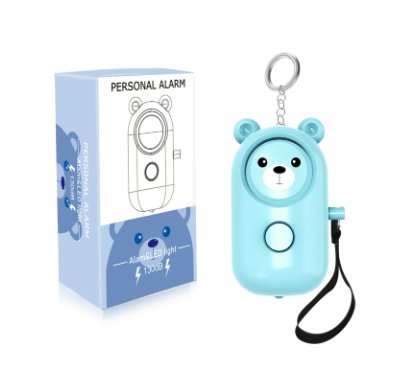
Wrist-worn alarms strap on like a watch or a band, and some are built into a bracelet. They are the best option for running, because your hands are free and the alarm is already where your hand is. The trade-off is size: a wrist alarm has to be small, so the battery and the speaker are smaller too. Check the decibel rating carefully on these, and check how it fastens — a strap that slips is worse than no strap at all. For example, the Cute Little Bear Personal Alarm is a wrist-strap model with a 130dB siren and an LED light.
Clip-on alarms have a belt clip or a carabiner and attach to a waistband, a bag strap or a jacket pocket. They are the most flexible of the four: the same alarm can go on your running belt in the morning and your coat pocket at night. The clip itself is the thing to check. A flimsy clip lets the alarm slide off and get lost, which is the most common way these end up unused.
This guide to personal alarms for women walks through the same choices — loudness, activation, flashlight and strobe — with real examples, and it is worth a read before you spend anything.
7 Things to Check Before You Buy
First, check the loudness — and read it with suspicion. Look for a decibel rating of 120 or more. Below 100, the sound will not carry across a busy street or a car park. But treat the number on the listing as a claim, not a fact: manufacturers test in different ways, and no independent body checks most of these figures. The honest test is to trigger the alarm once at home, outside, and listen from a distance. If it makes you wince from across the garden, it is loud enough. Warn the neighbours first.
Second, check the trigger with your eyes closed. This is the test that matters most, and it takes ten seconds. Hold the alarm the way you would carry it, close your eyes, and trigger it. If you fumble, if you have to look, if your thumb slides off the button — it fails. In a real moment your hands will be shaking and your attention will be somewhere else entirely. A personal safety alarm for women has to work on muscle memory, not on careful reading of a tiny switch. Pull-pin designs usually pass this test. Small recessed buttons often do not.
Third, decide where it will actually live. An alarm in the bottom of a bag is decoration. Think about your real day: the walk from the office to the car, the morning run, the bus home. Where does your hand go first? That is where the alarm goes — clipped to a waistband, on a wrist strap, on the outside pocket of your bag. If you run, a wrist or waistband alarm beats a keychain every time, because your keys are in your pocket or your armband, not in your hand. If you walk, a clip-on alarm on your coat or bag strap is the one you will reach without thinking.
Fourth, check the battery — and whether you can replace it. Some alarms run on small coin batteries, some on AAA, and some are rechargeable over USB. Coin batteries last a long time but need replacing, and the day the battery dies is the day the alarm is silent, so note the battery type and keep a spare. Rechargeable alarms are convenient until you forget to charge them, which is easy to do with a device you almost never use. Whichever type you buy, put a reminder in your phone: test the alarm once a month, and check the battery at the same time.
Fifth, look at the extras and ask whether they earn their place. A built-in flashlight is genuinely useful — it lights the path to your car and lets you see a lock or a step in the dark. A strobe light is useful too: it makes you visible and it is disorienting up close. A door or window sensor mode, found on some 3-in-1 models, turns the same device into a hotel-room alarm, which is handy for travel. But extras that add weight, size or a second switch you have to learn are not worth it. The alarm’s first job is to be loud and simple. Everything else is a bonus, not a reason to buy.
Sixth, check the water resistance if you run or walk in the rain. An alarm that dies the first time it gets wet is not an alarm you can rely on. Look for at least a splash-proof rating — IPX4 or better — if you run outdoors, and treat anything without a rating as an indoor-only device. The same goes for drops: a solid plastic or rubberised casing survives being knocked off a table. A thin, hollow-feeling shell cracks. Hold it in your hand before you decide. If it feels like a toy, it probably is one.
Seventh, think about who else might need to use it. If you are buying for a daughter, a mother or an older relative, the trigger has to work for their hands, not yours. A pull-pin is usually easier for stiff or arthritic fingers than a small button. A wrist strap is easier for someone who does not carry keys. And if the person you are buying for travels, check the rules where they are going: personal alarms are legal in all 50 US states with no permit, and they pass through airport security, but a combined device that also contains pepper spray or a stun function follows the stricter rules for that part, not the alarm’s rules.
When an Alarm Helps — and When It Doesn’t
An alarm helps most in the situations where someone is counting on nobody noticing: a quiet car park, an empty stretch of path, a stairwell, a hotel corridor. The noise breaks the plan — and that is the real job of a personal safety alarm for women. It also helps when you need to get attention fast and your voice will not do it — if you are out of breath from running, or if shouting feels impossible in the moment. And it helps as a first move alongside something else: the alarm goes off, and while everyone is looking, you move. Our guide to pepper spray for women covers the follow-up tool, but the order matters — noise first, distance second, anything else only if you have to.
It does not help much in a loud, crowded place where one more noise blends in, or if it is buried in your bag, or if the battery is dead. It does not help if you have never tested it and freeze trying to work out which end is which. And it does not replace paying attention. The best safety tool is still the habit of noticing — the footsteps behind you, the car that slows down, the route that is dark when it does not need to be. No device fixes the habit of not hearing what is behind you. The alarm is the backup. Your attention is the plan.
How to Carry One Without a Keychain
This is the part most guides skip, because they assume the alarm lives on your keys. For a standalone alarm, the carry is the whole point. For running, clip it to your waistband or wear it on your wrist, with nothing loose swinging — a dangling alarm bounces, tangles and gets left at home by the third run. For the walk to the car, clip it to the outside of your bag or your coat pocket, where your thumb can find it without opening anything. For travel, keep it in your jacket pocket on the plane and by the bed in the hotel, not in your suitcase.
Test the carry, not just the alarm. Wear your personal safety alarm for women on a normal day and see whether it snags, rattles, slips or annoys you. If it does any of those things, change the carry — a different clip, a different pocket, a wrist strap — before you decide the alarm itself is wrong. Most alarms are abandoned because of the carry, not because of the sound. The one you forget you are wearing is the one you will still have in a month.
If you run with earphones, keep one ear free or the volume low enough to hear footsteps and traffic. An alarm cannot help you if you do not hear the moment you need it.
Who a Standalone Alarm Suits — and Who It Doesn’t
A standalone personal safety alarm for women suits a runner who wants something on her wrist or waistband, a nurse or night-shift worker walking to the car after dark, a student who does not want another thing on her keys, and a traveller who wants one device that works in a hotel room as well as on the street. It suits anyone who wants the simplest possible tool: no training, no permit, nothing to aim.
It does not suit someone who wants a tool that physically stops an attacker — that is not what an alarm does, and anyone selling it that way is misleading you. It also does not suit someone who will not test it: an untested alarm is a guess, and a guess is not a plan. And if you already carry a personal alarm keychain that you like and actually carry every day, you may not need a second one at all — the best alarm is the one that is already in your hand.
The test is simple, and it is the same one we use for every safety tool: will you still be carrying it in a month, and could you trigger it without thinking twice? If the answer to both is yes, that personal safety alarm for women has done its job. It looks like nothing much. That is exactly why it works.
Frequently Asked Questions
Is a personal safety alarm for women as effective as pepper spray?
They do different jobs. An alarm draws attention and buys time; pepper spray creates distance. Neither replaces the other, and many women carry both — the alarm as the first move, the spray as the follow-up if someone closes the distance. An alarm has no legal restrictions in most places, which pepper spray does, so it is the easier one to carry everywhere.
How loud does a personal safety alarm for women need to be?
Look for 120 decibels or more. That is roughly as loud as a car horn a few feet away — enough to be heard across a street, in a car park, or through a closed door. Below 100 decibels, the sound does not carry far enough to matter outdoors. Test it once at home so you know what it really sounds like, because the number on the box is a claim, not a measurement.
Pull-pin or button — which is better?
Pull-pin is easier under stress: a big, obvious motion you can do with cold or shaking hands. A button is neater and will not snag, but only if the button is large enough to find by feel. Test both with your eyes closed and buy the one you can trigger without looking.
Can I take a personal safety alarm on a plane?
Yes. Personal alarms pass through airport security in carry-on luggage in the US and most other countries. Keep it in your jacket pocket or hand luggage, not in checked bags, so it is with you when you land. If your device also contains pepper spray or a stun function, different rules apply to that part.
Do personal safety alarms need batteries?
Most do — coin batteries, AAA batteries, or a rechargeable cell. Coin batteries last longest but need replacing; rechargeable ones need regular charging. Test the alarm once a month and check the battery at the same time, because a dead alarm is silent.
Is a wrist-worn alarm as loud as a clip-on one?
Usually slightly less loud, because the smaller body holds a smaller speaker and battery. Check the decibel rating on the specific model rather than assuming. For running, the trade-off is often worth it: a wrist alarm you actually wear beats a louder one left at home.